Moon Phases: Meaning, Cycle & Reflection
The Moon Cycle in Simple Terms
The article "Moon Phases - New Moon, Full Moon, and the Lunar Cycle" begins with a simple idea: you are watching sunlight reflected off the Moon change shape over time. The Moon itself does not glow or shrink; it is the shifting angle between the Sun, Moon, and Earth that creates the familiar pattern of phases. When we talk about Moon Phases, we are really talking about how much of the Moon’s day side we can see from Earth.
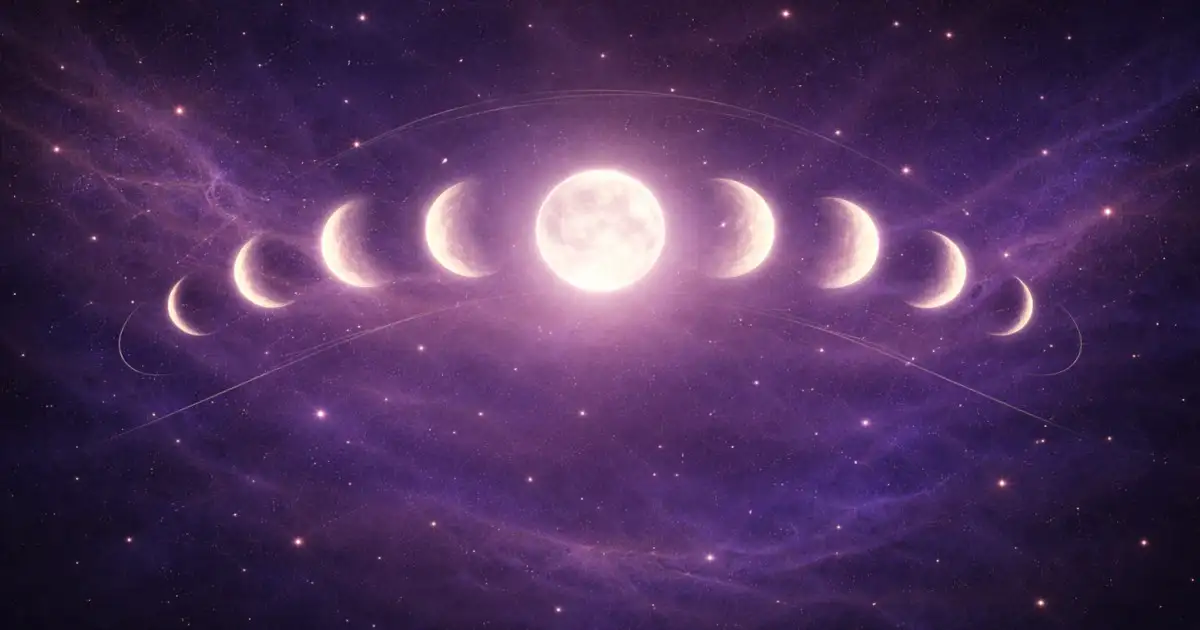
A full lunar cycle, or synodic month, lasts about 29.5 days. It starts with the New Moon, moves through the waxing crescent and first quarter, continues to the Full Moon, and then wanes back through the last quarter and crescent phases. This predictable rhythm is the foundation for many moon phases meaning traditions in both astronomy and moon cycle astrology.
You can think of the lunar cycle as a repeating story: darkness, first sparkle of light, steady growth, full visibility, and then soft release back into shadow. These changing light patterns are easy to follow with the naked eye, which is why they become a practical clock for gentle personal reflection. Rather than forcing outcomes, the Moon invites you to notice where you are in a natural, repeating process.
In Astrology, the Moon is often linked with emotions, instinct, and your inner world. Tracking Moon Phases alongside your Moon Sign can deepen the moon phases meaning for you personally, but you don’t need any complex tools to begin. Just watching the sky for a month can reconnect you with this simple pattern of light and dark.
New Moon Meaning
In the simplest terms, the New Moon is when the Moon sits between Earth and the Sun, and its bright side faces away from us. In the sky, it often looks like nothing at all: a dark, quiet Moon. Within moon cycle astrology, this darkness is not a bad sign; it represents a natural pause and a subtle reset point in the story of the lunar month.
The new moon full moon meaning pairing is often described as "seed and bloom." The New Moon is the seed moment - more about intention than instant results. It is an ideal time for gentle, grounded practices: clarifying what matters to you, setting a simple focus for the coming weeks, or identifying one small pattern you’d like to shift. This is non-predictive timing: you are choosing your direction, not obeying fate.
New Moon energy is quiet but not empty. You might feel more inward, reflective, or tired; you might also feel ready to plan and organize. Rather than asking the New Moon to guarantee success, you can treat it as a monthly invitation to begin again in a modest, realistic way. A single intention, written in a journal or said out loud, is enough.
If you use personal tools like a Birth Chart or book an Astrology Reading, you can explore how each New Moon interacts with your unique placements. Simanim-style personalized astrology readings often highlight how specific New Moons activate different life areas - work, relationships, self-care - so you can time your intentions gently instead of urgently.
Full Moon Meaning
The Full Moon arrives when the Earth sits between the Sun and the Moon, and we see the Moon’s day side fully lit. In the language of Moon Phases, this is the peak of visibility. Whatever began around the New Moon may now feel more obvious, tangible, or emotionally present, whether it is a project, a conversation, or an inner realization.
In many moon phases meaning traditions, the Full Moon is linked with culmination, clarity, and heightened awareness. That does not mean it must be dramatic or chaotic. Instead of viewing it as a guarantee of intensity, you can treat the Full Moon as a natural check-in point: What has come to light in the last two weeks? What truth are you finally ready to name?
The new moon full moon meaning contrast can be summarized as intention vs. illumination. The New Moon is about choosing a direction; the Full Moon is about seeing what is actually happening. This can be a time to acknowledge progress, confront avoidance, or gently release something that is not aligned - like a habit, a story you tell yourself, or a lingering resentment.
Avoid the hype that treats Full Moons as automatic crises. Instead, use them as scheduled clarity sessions. A simple Full Moon ritual might include reviewing your New Moon intention, noticing what unfolded, and then writing down one thing you’re ready to let go of. If you want tailored insight, an Astrology Reading can show how each Full Moon interacts with your Zodiac Signs and Rising Sign, grounding the symbolism in your lived reality.
Waxing and Waning Phases
Between New Moon and Full Moon, the Moon is waxing, which simply means the visible light is increasing. This half of the lunar cycle is often associated with growth, building, and taking step-by-step action. In moon cycle astrology, waxing phases support moving from idea to implementation - making plans, laying foundations, practicing new habits.
After the Full Moon, the Moon is waning, and the light gradually decreases. The waning half of the cycle is associated with review, adjustment, simplification, and release. Instead of striving to do more, you’re encouraged to discern what is enough and what can be let go. In many moon phases meaning systems, this is the time to edit, refine, and clear space.
The quarter moons - first quarter (waxing) and last quarter (waning) - are key adjustment points. They appear as half-lit Moons and often coincide with moments of choice or tension: do you commit more fully, or do you shift course? The first quarter favors problem-solving and taking practical steps; the last quarter favors wrapping up, renegotiating, or gently exiting what no longer fits.
When you view Moon Phases as two halves - waxing for building, waning for releasing - it becomes easier to plan your month in a way that feels kind rather than rigid. You might schedule brainstorming, outreach, or new projects in the waxing phase, and decluttering, reflection, or endings during the waning phase. Over time, this rhythm can make your calendar feel more humane and less random.
How to Use Moon Phases for Reflection
Using Moon Phases for reflection does not require elaborate rituals. A simple framework is: notice where the Moon is, ask a few gentle questions, and take one small action. This keeps moon cycle astrology practical and grounded, focused on awareness rather than prediction.
At the New Moon, you might journal on questions like: What matters most this month? Where do I want to invest my energy? What am I ready to begin, even in a tiny way? Write down one to three intentions, keeping them specific and manageable. This is about direction, not pressure.
During the waxing phase, check in: What is one next step I can take? What support would make this easier? You might schedule tasks, reach out to a collaborator, or start a small daily practice. At the Full Moon, reflect: What has come to light? What is working, and what is not? This is a moment for honest seeing, not self-criticism.
In the waning phase, focus on release and integration: What can I simplify? What am I ready to put down? A small action - deleting unneeded files, saying no to a draining commitment, adjusting a goal - aligns you with the phase. Resources like Daily Astrology reports or a personalized Astrology Reading can help you align your check-ins with the current Moon without turning it into something rigid or superstitious.
Common Pitfalls
One common pitfall with Moon Phases is treating them as fixed rules or absolute predictions. The Moon does not demand that you act in a certain way; it simply offers a repeating pattern you can choose to work with. When moon phases meaning turns into "shoulds" and fear-based timing, the practice stops being supportive.
Another trap is expecting every New Moon or Full Moon to be dramatic. Most lunar cycles are quiet and ordinary, and that is healthy. If you chase intensity or assume that a Full Moon guarantees chaos, you may overlook the subtle, meaningful shifts that actually help you grow.
It is also easy to use moon cycle astrology as a way to avoid responsibility. Blaming the Moon for every mood or decision can keep you from owning your choices. A more empowering approach is to notice correlations - "I tend to feel more reflective near the waning Moon" - without treating them as excuses or destiny.
Finally, try not to isolate Moon work from the rest of your Astrology toolkit. Your Moon Sign, Birth Chart, and even transits like Mercury Retrograde can all color how you experience each phase. Simanim-style, personalized interpretations make Moon Phases a supportive backdrop rather than a rigid script, helping you use the cycle for gentle timing, reflection, and self-trust instead of fear or absolutism.
Astrology Explained: How It Works & Reflects You
Astrology explained in clear language: learn what astrology is, how it works, and how to use it as a calm, grounded tool for self-understanding.
Zodiac Signs: Dates, Elements & Meanings
Learn the 12 zodiac signs, dates, elements, and meanings in a grounded beginner guide. Understand your sign without stereotypes and use astrology wisely.
Moon Sign Meaning: Emotions and Inner Needs
Discover your Moon sign meaning in astrology and learn how it reveals your emotions, inner needs, and private self for calmer, clearer emotional awareness.
Rising Sign Meaning: Your Ascendant Explained
Discover how your Rising sign (Ascendant) shapes first impressions, your approach to life, and the way your entire birth chart opens and unfolds.
Birth Chart: Your Natal Chart Explained Simply
Learn what your birth chart (natal chart) is, how to create it, and how to read planets, signs, and houses in a clear, beginner-friendly way.
Zodiac Compatibility Explained with Nuance
Discover how Zodiac Compatibility really works, what it can and can’t predict, and how to use astrology compatibility for insight and growth in relationships.
Daily Astrology: A Gentle, Grounded Check‑In
Discover a calm Daily Astrology practice that helps you track mood, timing, and focus each day without rigid predictions or fear‑based horoscopes.
Mercury Retrograde Meaning: Calm, Clear Guide
Mercury retrograde explained calmly: what it means in astrology, common myths, and practical tips to stay grounded, organized, and confident.
Astrology vs Horoscope: What Really Differs
Discover the real difference between astrology and horoscopes, how each works, and how to use both in a grounded, reflective, and empowering way.